
Tracing the origins of the Lucenó family
Genealogy, historical records, and genetic research into the Lucenó families of San Vito sullo Ionio, Calabria.
The Luceno Origins Project is an effort to reconstruct the history of a small and uncommon Italian family: the Lucenós of San Vito sullo Ionio, a hill town in Calabria.
Surviving civil records allow us to trace the family into the eighteenth century and reconstruct many of its nineteenth-century branches. Genetic genealogy provides another form of evidence—one that may eventually answer questions the surviving records cannot.
What the records reveal
By the late eighteenth century, several Lucenó households were established in San Vito. Although the surviving records identify many of their marriages, children, and deaths, they do not tell us how all these families were related.

Two early family groups are particularly important to the present research.
One descends from Giuseppantonio Lucenó and Catarina Vasta. Their grandson, Vito, and his wife, Chiara Fani, are the most recent common ancestor of several of the Luceno branches later found in North America.
Another descends from Franceso Lucenó and Rosa Ciraco. Many of their known modern descendants appear to come through their descendent, Saverio, and his wife, Maria Rosa Totino.
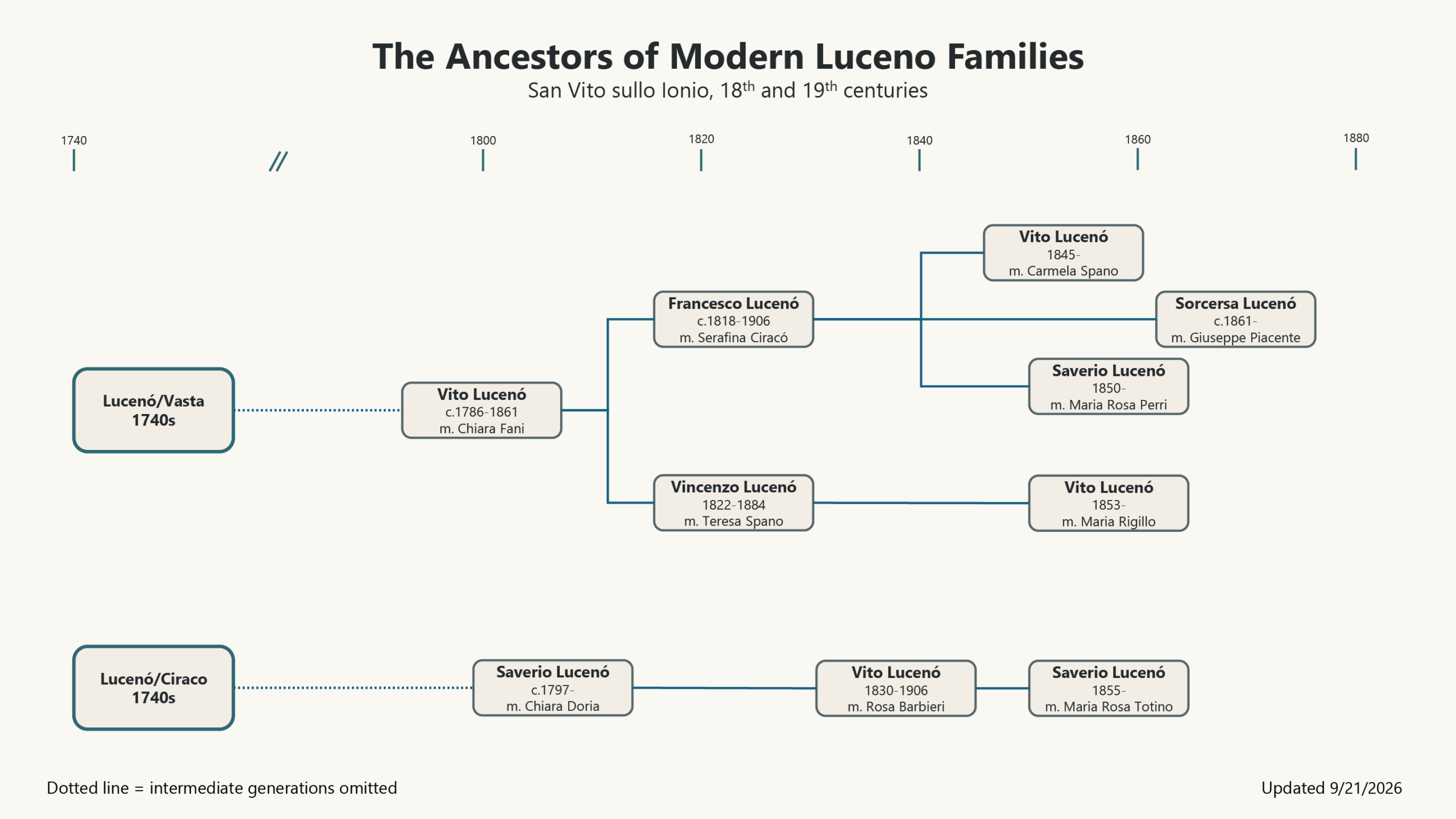
The documentary record places these families in the same small town at approximately the same time. What it does not securely establish is how closely their Lucenó ancestors were related.
The central mystery
The principal question of the project is simple:
Did the early Lucenó families of San Vito descend from a recent common ancestor?
The surviving documents appear to lead the two principal groups back to different eighteenth-century fathers: Giuseppantonio Lucenó and Francesco Lucenó, both born around the middle of the 18th century.
They may have been brothers, cousins, or members of more distantly related families. It is also possible that parts of the reconstructed genealogy are incomplete, or that one of the historical records identifies a biological relationship incorrectly.
Earlier church records that might have answered the question no longer survive. According to local history, San Vito’s older ecclesiastical records were lost during the devastating Calabrian earthquakes of 1783.
What DNA is telling us
Autosomal DNA testing has identified a repeated genetic connection between documented descendants of the Luceno/Fani and Luceno/Doria families.
The amount of DNA shared across the two groups is often comparable to that shared among the most distant documented descendants within the Luceno/Fani family itself. This suggests that the two groups may have been relatively close, but autosomal DNA alone cannot establish whether their ancestors were brothers, cousins, or connected through several San Vito families.

The project has also completed a Big Y paternal-line test for a descendant of the Luceno/Fani group. His present Y-DNA haplogroup is R-FTH68628.
No sufficiently close Big Y match has yet been found. As a result, the recent Luceno portion of the paternal tree remains unresolved.
Strategic Big Y testing of patrilineal Luceno men from other branches could determine whether the early Luceno families shared a recent male ancestor and could begin to create a genetic family tree for the Lucenos of San Vito.
Where the research stands
The project has so far:
- Traced the principal surviving Luceno families through the civil records of San Vito.
- Identified at least eight children of Vito Lucenó and Chiara Fani and at least six children of Saverio Lucenó and Chiara Doria.
- Reconstructed multiple descendant branches in Italy and North America.
- Compared Luceno DNA matches across four different Ancestry test kits.
- Identified a recurring autosomal connection between the Lucenó/Fani and Lucenó/Doria groups.
- Completed the first high-resolution Big Y test for the family.
- Identified living branches whose DNA could help resolve the remaining questions.